
A Problem Almost Every Grower Encounters
If you’ve ever worked with aeroponics, this situation may feel familiar:
You use a nutrient formula that works perfectly in substrate systems like coco peat.
EC and pH are within range. Everything looks fine.
But once you switch to aeroponics—
problems start to appear:
- Yellowing new leaves
- Burnt edges
- Stunted growth
And the most confusing part?
Your nutrient solution is not missing anything.
So what’s really going wrong?
Aeroponics Is Not “More Advanced”—It’s More Direct
Many growers assume aeroponics is just an upgraded version of hydroponics.
In reality, it’s closer to this:
A system with all buffering removed
In substrate systems, roots are “protected”:
- Water is stored
- Nutrients are buffered
- Release is gradual
Even if your formula isn’t perfect,
the substrate smooths things out.
In aeroponics, none of that exists.
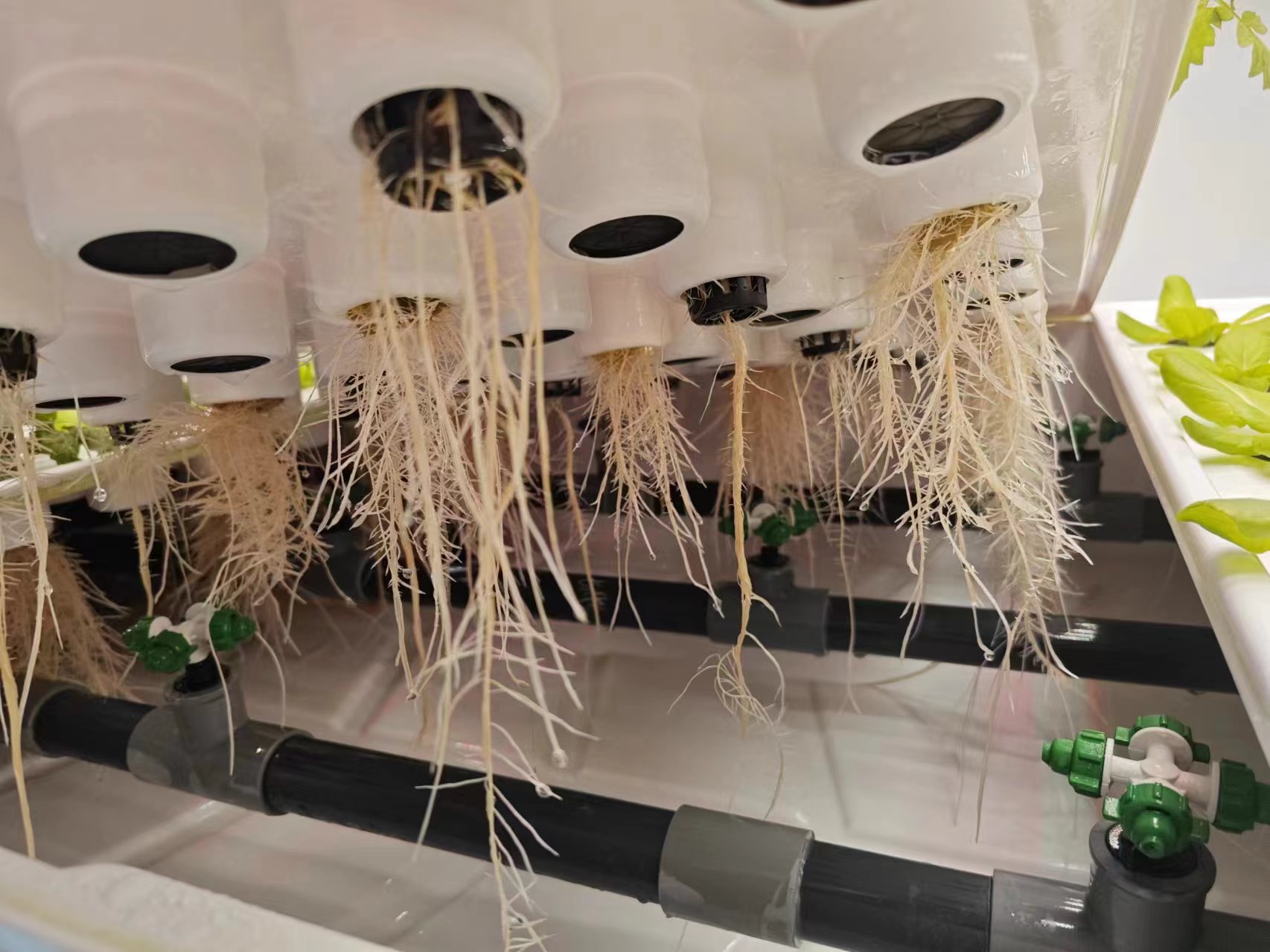
Roots are fully exposed.
What you spray is what they get.
No buffer. No delay. No correction.
Why the Same Formula Fails in Aeroponics
- Errors Are No Longer Hidden—They’re Amplified
In substrate systems:
Small mistakes are often tolerated.
In aeroponics:
The same mistakes hit the roots immediately.
That’s why aeroponics feels “hard to tune”
It’s not harder—
It’s less forgiving
- Fast Uptake Can Work Against You
Aeroponic roots absorb nutrients extremely fast due to high oxygen levels.
If your solution has slightly higher:
- Potassium (K)
- Ammonium (NH₄⁺)
They are absorbed first—and aggressively.
This blocks:
- Calcium (Ca)
- Magnesium (Mg)
Result:
Deficiencies even when nutrients are present
This is known as:
physiological deficiency
- The Root Zone Is Highly Unstable
In aeroponics, roots are covered by only a thin film of water.
As plants absorb nutrients, they constantly change this microenvironment:
- pH shifts instantly
- Local EC fluctuates
If pH drifts outside 5.5–6.5:
- Key nutrients precipitate
- Become unavailable
And this doesn’t happen slowly—
It happens almost instantly
- Sometimes It’s Not the Formula—It’s the Mist
One overlooked factor:
The mist itself is the delivery system
If droplets are:
- Too large → they drip off
- Too small → they evaporate quickly
Either way:
Roots don’t receive stable nutrition
So How Do You Make Aeroponics Work?
In one sentence:
Stop “feeding plants”—start managing a system
Adjustment 1: Lighter, More Stable Nutrients
- Reduce EC to 50–70% of hydroponics
- Use chelated micronutrients
- Increase calcium ratio
Goal:
Stability over intensity
Adjustment 2: Spray strategy is more important than formula
In aeroponics, spraying is as important as nutrition itself.
First, droplet size:
Recommended range: 50–100 microns
Too big or too small both cause problems.
Second, spray interval:
A common starting point:
- Spray: 5–10 seconds
- Stop: 3–5 minutes
But this is not fixed.
It must be adjusted based on:
- Crop type
- Root mass
- Growth stage
- System layout
A practical rule:
Roots should always be moist,
but never dripping.
One more important detail:
There is always a delay between pump start and actual spraying.
So if you set 5 seconds,
the effective spray time at the roots may be much shorter.
This needs to be tested in real conditions.
Adjustment 3: Treat Temperature as a Core Variable
Many failures are not caused by nutrients—
but by temperature.
Aeroponic roots are fully exposed and highly sensitive.
Optimal range:
18°C – 22°C
Adjustment 4: Assume Clogging Will Happen
In aeroponics:
Clogging is not a minor issue—
it is a system failure
You need:
- Fine filtration (≥120 mesh)
- Regular cleaning
Because when failure happens—
it happens fast
A More Realistic Conclusion
Aeroponics is powerful.
But it is not easier.
It is:
a high-performance system without a safety net
If you’re transitioning from substrate growing,
the biggest change isn’t equipment—
It’s mindset:
From experience-based growing → precision control