
A situation most teams run into
Let’s start from something very practical.
You take a crop that’s already running well. The same variety, the same nutrient formula. In coco peat or peat moss, everything looks stable. Growth is uniform, no obvious deficiencies.
Then you move that exact setup into aeroponics.
Within a short time, problems start showing up. New leaves turn pale, edges dry out, and it looks very much like calcium or magnesium deficiency.
At this point, most people question the formula first. But in many cases, the formula hasn’t changed at all. What changed is the environment the roots are living in.
The real difference: buffering vs direct exposure
The easiest way to understand this is to think in terms of buffering.
In substrate systems, the media is doing a lot of hidden work. It holds water, stores nutrients, and most importantly, it slows everything down. When EC or pH shifts slightly, the roots don’t feel it immediately. The media absorbs part of that change and releases it gradually.
So even if your management is not perfect, the system gives you some tolerance.
In aeroponics, that layer is gone.
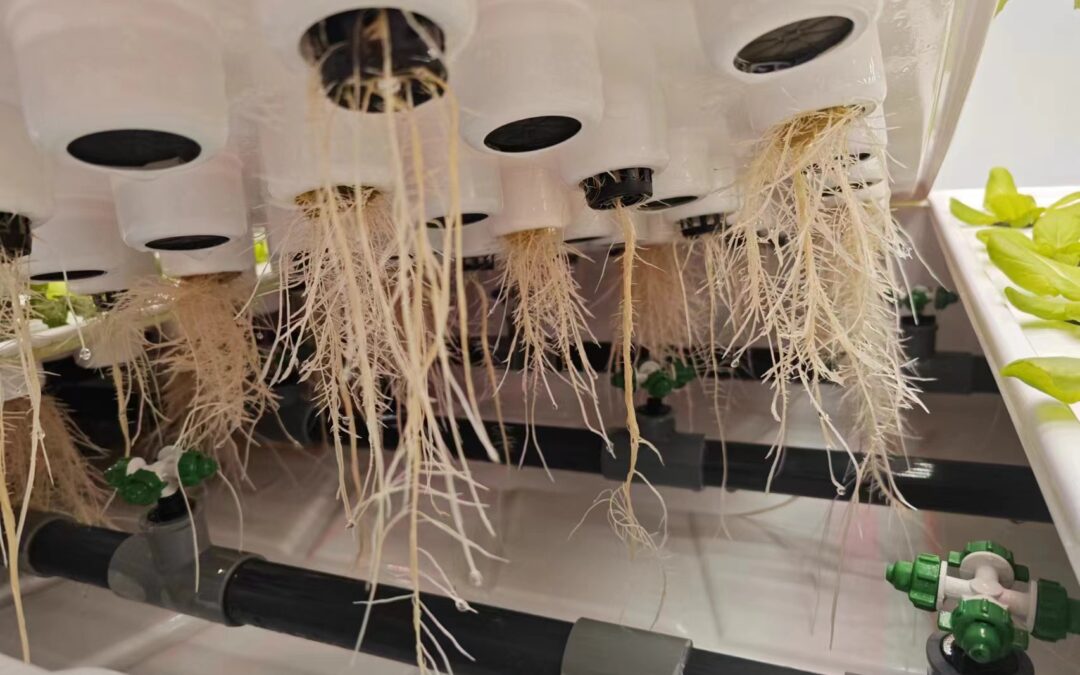
The roots are exposed directly to whatever the system delivers. There is no storage, no delay, no protection. If something is slightly off, the roots feel it right away. That’s why aeroponics reacts faster, but also fails faster.
What actually goes wrong inside the system
Once you understand that there is no buffer, the common problems start to make sense.
Fast ion competition
In aeroponics, roots sit in a high-oxygen environment, which makes nutrient uptake very active. This sounds like an advantage, but it also creates imbalance more easily.
For example, if potassium or ammonium is slightly higher than ideal, the plant will absorb those ions very quickly. When that happens, calcium and magnesium uptake gets suppressed. The plant then shows classic calcium deficiency symptoms, even though calcium is still present in the solution.
So the issue is not always “missing nutrients,” but “blocked uptake.”
Unstable microenvironment around the root
Another thing that becomes more obvious in aeroponics is how unstable the root surface environment can be.
As roots absorb nutrients, they release ions that shift the local pH. In substrate systems, the media absorbs and neutralizes these changes. In aeroponics, the root is only covered by a thin film of water, so the pH of that layer can change very quickly.
Once the pH drifts out of range, some nutrients—especially iron, manganese, zinc, and calcium—can become unavailable almost immediately. They are still in the system, but not in a form the plant can use.
Mist quality affects delivery, not just availability
In traditional systems, as long as water reaches the root zone, nutrients are there.
In aeroponics, it’s different. Nutrients are delivered through droplets, so the physical behavior of the mist matters a lot.
- If droplets are too large, they fall off quickly and don’t stay on the roots long enough
- If droplets are too fine, they evaporate fast and can leave salts behind
In both cases, the plant is not receiving nutrients in a stable way. So even with a correct formula, you can still see deficiency symptoms.
Very little margin for error
Another important difference is how quickly problems develop.
In substrate systems, mistakes often take time to show. You might have a few days to react.
In aeroponics, the system is much more immediate. If a nozzle is blocked or a spray cycle is off, the plants can start showing stress within hours. That makes system reliability and consistency much more important.
How we need to adjust our approach
To run aeroponics well, we have to shift our mindset.
It’s no longer about “providing enough.”
It’s about “controlling precisely.”
Here are the main areas to focus on.
1. Nutrient solution: less concentration, better balance
One of the most common mistakes is using the same EC as in substrate systems.
In aeroponics, uptake efficiency is higher, so the required EC is lower. In most cases, running at about half to two-thirds of the substrate EC works better.
Higher concentration does not mean better growth. It often leads to stress and stronger ion competition.
At the same time, micronutrients need to be more stable. Using chelated forms (like EDTA or DTPA) helps prevent them from becoming unavailable in a high-oxygen environment.
Another practical adjustment is to slightly increase the calcium ratio while keeping potassium under control. This helps reduce the chance of calcium being blocked during uptake.
2. Misting strategy: this is as important as nutrition
In aeroponics, how you deliver nutrients is just as important as what you deliver.
There are two key factors here.
Droplet size
The general target is around 50–100 microns. This range allows droplets to stay on the roots long enough without dripping or evaporating too quickly.
Spray timing
Most systems use a short spray and longer pause cycle. For example, a few seconds of spraying followed by a few minutes of rest.
But these numbers are not fixed. They depend on:
- Crop type
- Root density
- Growth stage
- System layout
A simple way to judge is by observing the roots. They should stay evenly moist, but you should not see water dripping off them.
One detail that often gets overlooked is system delay. There is always some time between when the pump starts and when mist actually reaches the roots. If you don’t account for this, your effective spray time may be shorter than you think.
3. Root-zone temperature: easy to ignore, but critical
Because the roots are fully exposed, temperature has a direct impact.
A stable range between 18°C and 22°C generally works well. If the temperature goes higher, root respiration increases and problems like disease or nutrient imbalance become more likely. If it drops too low, nutrient uptake slows down, especially for phosphorus.
This is one of those parameters that doesn’t always get attention early on, but it makes a big difference in consistency.
4. System reliability: especially clogging prevention
In aeroponics, hardware reliability is not just a maintenance issue, it’s a survival issue.
If a nozzle stops working, the plants in that area can dry out very quickly. There is no buffer to protect them.
So two things are essential:
- Fine filtration (at least 120 mesh)
- Regular cleaning to prevent salt buildup
Without these, even a well-designed system will run into problems.
Bringing it all together
If we step back, aeroponics is not simply a more advanced version of hydroponics. It is a system that removes all buffering and exposes the plant directly to every decision we make.
That’s why it feels more sensitive. Small imbalances that would go unnoticed in substrate systems become visible very quickly.
But the same characteristic is also its advantage. When controlled well, the system responds fast and efficiently.
So the key is not just experience, but control. The better we manage concentration, balance, misting, temperature, and system stability, the more consistent the results will be.